

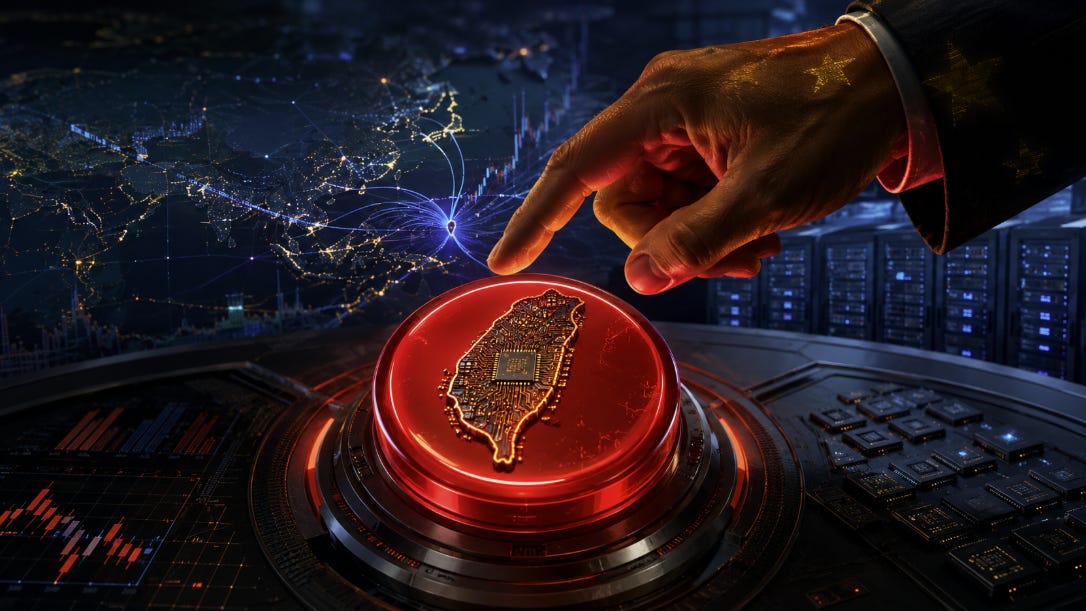
100→10?
Pick a company at random. Make it a large public company. John Deere you say? Okay, let’s go with that. Now - let’s jump through a portal into a hypothetical world where John Deere is prohibited from improving their products for 18 months. Everyone else can keep on doing their things, but John Deere specifically cannot improve their products for 18 months. What happens to John Deere’s sales over the coming period?
John Deere is currently expected to increase sales by mid-high single digits. I’d posit (with a high degree of confidence) - that if John Deere were to completely stop improving their products over the next 18 months - the impact on sales would be near zero - they probably still go up the same amount they otherwise would have. To be sure - if they were going to stop improving their products for a period of say 5 years or maybe even 3, that might start to nibble into the business. But a year and a half wouldn’t touch it. Why? There are all sorts of reasons.
Competitors don’t have enough time to do anything meaningful to take share, and even if they invented something great they still have to get it into production which is itself at least a year long process, and then they have to build capacity which is a multi-year process.
Let’s pick another company at random and do this exercise again. Apple you say? Excellent choice. So now John Deere is left alone to do as it pleases, but in our hypothetical universe through the portal, this time Apple is not permitted to make any improvements to their products for a year and a half - what happens to sales?
Jokes on social media abound about how nothing changing is the status quo for Apple these days. Apple increases memory a bit, makes the camera better, improves the processor on the computers, sure - but not by enough to make the jokes unfunny. Most Apple sales are driven by devices getting upgraded b/c they’re multiple generations behind (so even a current device purchased a year after it came out [b/c they’re not getting upgraded for this year] would be an upgrade). In fact, lots of people prefer to purchase devices that are a single generation behind b/c they’re boomers and remember how the latest greatest versions of things always had bugs that needed working out. Net-net I think if Apple makes zero improvements to its products we’re looking at maybe very low single digit declines in revenue growth rate - but the business probably still grows just at a slightly lower pace.
Do you see where I’m going with this? Now instead of choosing a company at random for this hypothetical, let’s pick a company in particular. Let’s choose Anthropic. What would happen to Anthropic’s revenue if it were to stop improving its product for 18 months?
We all know the answer. It would plummet by at least 50% and probably closer to 90%. 3-6 months after the product stops improving there would be numerous other models who match its capabilities. 3-6 months after that there would be multiple models who surpass its capabilities. 3-6 months after that everyone would have switched to the new models. The only thing left for Anthropic to do would be to sub-let the compute capacity it has locked up.
This is a truly bizarre and unprecedented situation. Anthropic is going to IPO likely with a valuation between 1.5 and 2 Trillion dollars - and its moat is so dependent on continuous improvement that if it were to stop improving then the value of the business would drop 90% (or more) in a little over a year (hence the title of this section 100→10). This rapid rate of obsolescence in terms of value and ability to generate revenue doesn’t exist anywhere else in the corporate world.
Sure, we have things like solar panels, TVs, laptops etc - hardware that depreciates rapidly - but the difference in rate at which their products become fucking useless (henceforth, the BFU rate) is at least an order of magnitude slower. What’s more - if you look at the R&D dollars being spent to improve solar panels - it’s a pittance compared to the dollars already invested in solar panel R&D previously (2027 forecast is that R&D into solar panels will be equal to around 1% of solar panel sales). I’m sure the case is similar for TVs, Laptops, etc. The point is that no one is gunning for this business. On the other hand - you can essentially take the portion of new compute capex that is intended to be allocated toward training and consider that R&D gunning for anthropic. Dylan Patel of Semianalysis just this week said he expects training’s share of compute to be around 40% - while consensus for 2027 is in the 20-30% range. The math gets even funnier. If we combine OpenAI, Anthropic, Google, Azure, AWS etc we might land around $500 billion at a run rate of AI revenue by the end of this year. If we have $1T in capex with 30% of that going to “R&D” then we have $300B R&D budget against $500B of revenue → so the figure to compare against the 1% R&D spent on solar panels is the $300B out of $500B or 60%!
These are indeed crazy times. Meta hired Alexander Wang to revamp their in-house AI efforts by buying 49% of his company for $14.3B - this was their way of getting around antitrust - all they really wanted was Wang and a handful of his team. How could any team - particularly a small team of HUMANS be worth $14.3B? Well, if you are spending $100B a year on AI capex what’s another $14.3B to make sure that capex is well spent? That was the logic and so far it actually seems to be panning out.
Safe Super Intelligence - the company started by Ilya Sutskever after he left OpenAI - is valued at $32B and has zero revenue.
But this whole situation is only going to get even more insane.
$360 Billy? No ty
By the end of 2026 OpenAI and Anthropic are expected to have on the order of 5-6GW of compute capacity. For perspective, Anthropic leased compute capacity from SpaceXAI (Elon) for $50B per gigawatt! By the end of next year estimates are that OpenAI and Anthropic will have 18GW between them. Let’s say this happens…
Labs make money by selling inference. Training just makes their models stay up with the times (i.e. not go to being worth zero). If compute prices are $50B per GW then we’re looking at $50B X 18 = $900B of potential run rate revenue by December 2027.
But - get this - if they choose to spend 40% of compute on training instead of inference, they essentially forego $360B (40% of $900B) of revenue in favor of using that money to make a better model. Imagine being in the CFO chair and needing to decide whether to turn down a cool $360B of revenue to invest in “R&D”. Lmfaoooooo. Strange times.
Personally I think the odds are slim to none that OpenAI and Anthropic end up hitting those revenue figures. It’s also a big assumption that compute can command $50B of revenue per GW. Still though, even if they’re off by 50% the numbers are historically unprecedented and wild to think about.
But the situation gets crazier still…
TSMWHO?
Here’s a list of some of the largest buyers of TSMC (Taiwan Semiconductor Manufacturing Company) chips:
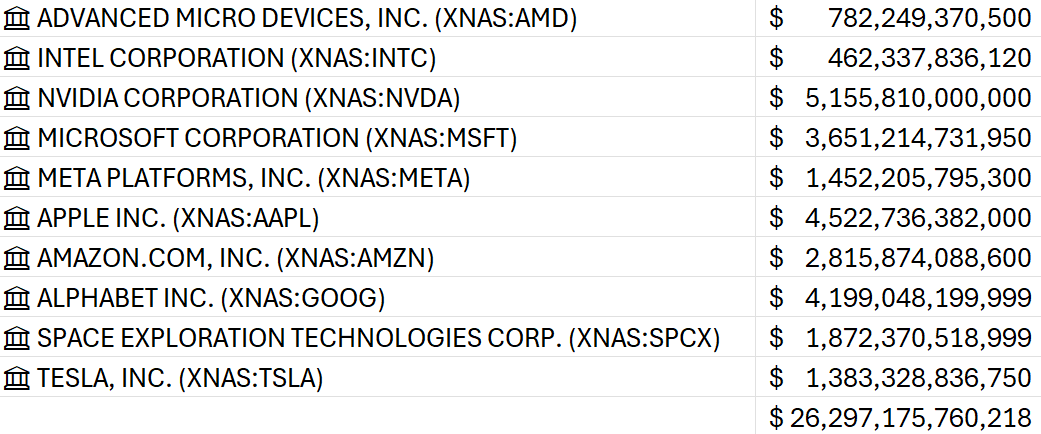
In the right column are their current market values. Note the total is $27T - about 85% of US GDP. Add the $2T+ for Anthropic and OpenAI - and other AI companies who are completely dependent on the AI ecosystem, and we easily have our entire GDP worth of market cap accounted for.
If China decided to block TSMC from exporting chips, Apple’s revenue drops 60%+, cloud growth at Azure, GCP, AWS, SpaceXAI all goes to ZERO. Nvidia sales go to zero, AMD sales go down 90%. Tesla vehicle production gets cut in half. Meanwhile thanks to the wealth effect the US economy goes into a deep recession if not outright depression. The US stock market would probably drop by more than half in a couple of weeks if China put a blockade around Taiwan. China can EASILY blockade Taiwan - note this is not the same thing as invading it.
Ben Thompson of Stratechery pointed out in one of the best interviews I’ve ever seen that China would do this (blockade) in the event that some US lab succeeds at creating a model that recursively self improves and it becomes evident that such improvement will lead to a permanent military advantage for the United States. The game theory seems pretty basic. If you were China - and you saw how insane, hostile and unpredictable American leadership was - would you let them become the sole military power? Unlikely…
Make no mistake. At this point we are at the complete discretion and mercy of China. They can destroy our economy at will - meanwhile we have nothing remotely comparable in terms of weapons to fight back with. Yes their economy would be crushed too, but not nearly as bad as ours.
Their supply chain is damn near independent from the US and becoming more so every day. We still supply some critical machinery like semicap and aerospace equipment but they’re building more and more in-house all the time. The US used to have a chokehold on certain straits (Malacca, Lombok) that enabled us to block oil imports to China from the middle east, but thanks to the Iran war we now know that this control is greatly diminished. The reason oil never spiked as high as people expected is because China has such large internal reserves they were able to cut imports by 50% and still be fine. Don’t forget Russia…
Meanwhile the US economy has NEVER been more dependent on TSMC than it is right now - and it’s rapidly becoming ever MORE dependent on TSMC b/c that’s where all of the exponential growth from AI is coming from. Again - let me stress - the faster AI grows the greater our dependency grows - the more powerful the lever China has over us.
Btw - here’s a map of Taiwan, as you can see it is a tiny island just off the coast from China. It would be trivial for China to put a bunch of ships around it that completely halted imports and exports - and equally trivial to make a no-fly zone
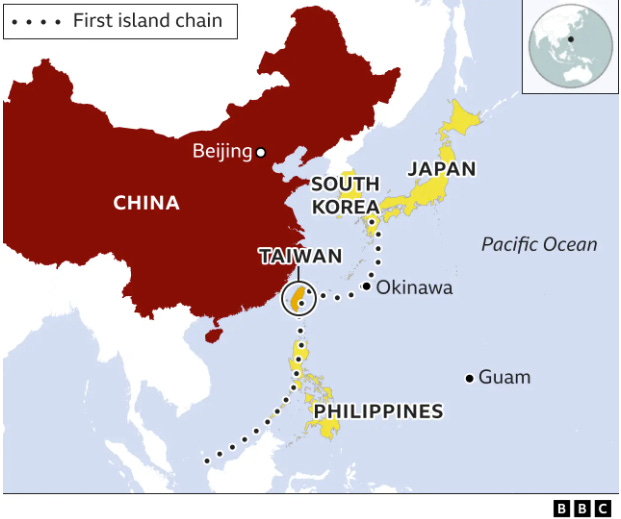
Everyone knows this. We don’t speak about it b/c it would be a super embarrassing thing for our leaders to admit the position we’re in. But if you follow the actions of our Big Tech CEOs - Elon and Jensen in particular, it’s obvious they all get the situation. Our politicians probably sort of get it too. Note the recent pressure on TSMC to build fabs in the US. However, currently 90%+ of TSMC capacity is in Taiwan, including ALL of the most cutting edge nodes. 2027 forecasts show TSMC spending 75%-85% of capex in Taiwan with the remainder being split overseas mostly in the US and Japan. We’re becoming more, not less dependent!
Now - China obviously will not push the button unless they feel very threatened. Their own economy would be wrecked too, just not nearly as badly as ours - and to be sure their tolerance for pain is far higher than ours. Thankfully, they probably feel less threatened than they ever have. The US is spending trillions of dollars per year to build an ever increasing dependency on them (vis-a-vis Taiwan), and they’re just sitting back and marveling at the absurd luck of having TSMC 100 miles off their coast.
Today, we are on the cusp of still maintaining a “mutually assured destruction” scenario. Meaning - we can still inflict massive pain to China even if they can disproportionately hurt us. But we’re probably only a few years out from no longer being in a MAD scenario - and instead simply being in a “China has a red button they can push at any time” scenario.
In a nutshell…

To Summarize:
We have multiple Trillion+ companies whose value would drop 90% in an instant if they stopped investing biblical amounts in R&D - and whose products would become obsolete in <18 months
Humans with some special maths in their head are now worth $10B+
CFOs next year will have to decide whether to forego hundreds of billions in revenue from inference in favor of “R&D”
Our entire GDP worth of market cap relies on China being nice
Exponential AI growth is causing the US economy to be ever more reliant on China being nice
Chad Jinping is the happiest man on Earth